
Pulling Rank: Using Fused Retrieval to Bridge the Alias Gap
New to this series? Open for context
Engineering the Rules Oracle
Modern tabletop games rely on fragmented rulebooks, supplements, and changing FAQs. The Rules Oracle is a hosted Q&A engine built to return cited, page-referenced answers to complex rules questions. This series covers the engineering behind it.
Access is currently invite only during the beta period.
- Part 1: In Good Character: Designing an Ingestion Pipeline for Hostile Tabletop Rules
- Part 2: Pulling Rank: Using Fused Retrieval to Bridge the Alias Gap ← you are here
- Part 3: Fielding Questions: Using JSON Constraints to Force Grounded Answers
- Part 4: Preventing RAG Regressions: Eval Harnesses and Production Gates
Some of my first test questions came from a Discord server where people play the game. I scrolled back through old posts and pulled real questions players had already argued about. One of them:
Is there a specific base size for a Warlord on horse?
The answer lives in the Bases section. That section defines base sizes for Heroes on horses. It never says “Warlord.” The Heroes section defines that a Warlord is a type of Hero. No single chunk contains both “Warlord” and “base size.”
Single-lane semantic search kept returning Warlord stat blocks, special rules, lore. The Bases chunk never made the cut. That is a vocabulary problem, not a parsing problem. Let’s call it the Alias Gap: the book defines a rule at one level of its taxonomy (Hero), the question names a specific type (Warlord), and one embedding of the question will not reliably connect them.
Why Vibes Are Not a Search Strategy: Two Failure Modes in Dense Retrieval
Dense embeddings cluster concepts that sound related. That helps until a rule lives under a parent category and the question names a subtype that section never spells out. Two failure modes showed up early.
The vocabulary mismatch. Warlord is not slang for Hero. Both words are in the rulebook. A Warlord is defined as a type of Hero. The Bases section just says Hero. I could fine-tune a custom embedding model on this ruleset. That path keeps charging: a new tuning run and full re-embed every FAQ, plus a self-hosted stack I would have to operate instead of calling a hosted API. I was not looking for recurring prices when architecture could answer the question cheaper. Fine-tuning is paying rent on your vectors every FAQ season. Multi-lane retrieval is fixing the call numbers once.
The supersession mismatch. Tabletop games ship FAQs and errata that replace old rules with new text. Wargames, board games, RPGs: same pattern. Replacement language often embeds far from the original. In direct testing I saw FAQ pairs around 0.59 cosine similarity A score for how aligned two embedding vectors are, typically between 0 and 1 for similar text. Higher means the chunks occupy similar directions in vector space. In the FAQ supersession work, a replacement pair topped out around 0.59 — too low to treat vector similarity as the primary match signal. : about as close as unrelated paragraphs from different books. Surfacing the zombie rule from the old edition is worse than returning nothing. That problem wants a different tool (I come back to it below).
The Fix: Two Embeddings for One Question
I did not start with a lookup table. I started with a simpler question: if I already know a Warlord is a Hero, what would I embed to find the Bases section?
That became two dense lanes plus lexical search, fused at the end.
Expanded dense keeps the player’s words and adds a nudge toward the category:
Is there a specific base size for a Warlord on horse? [warlord (hero)]
The vector stays anchored to “Warlord.” This lane is good at chunks that mention Warlord directly or state that a Warlord is a Hero.
Canonical dense replaces the alias with the book’s category term:
Is there a specific base size for a hero on horse?
This lane reaches chunks written about Heroes, including Bases, which never mentions Warlord at all. That was the chunk single-lane retrieval kept missing.
Lexical runs Postgres full-text search on the original question. Embeddings flatten rare tokens into neighborhood averages. Lexical search still cares that the user typed a faction name or ability title exactly as printed.
Without the canonical lane, Bases scores too low because “Warlord” means nothing in that text. Without the expanded lane, I can miss the definitional bridge chunk. I run all three in parallel, then merge the ranked lists.
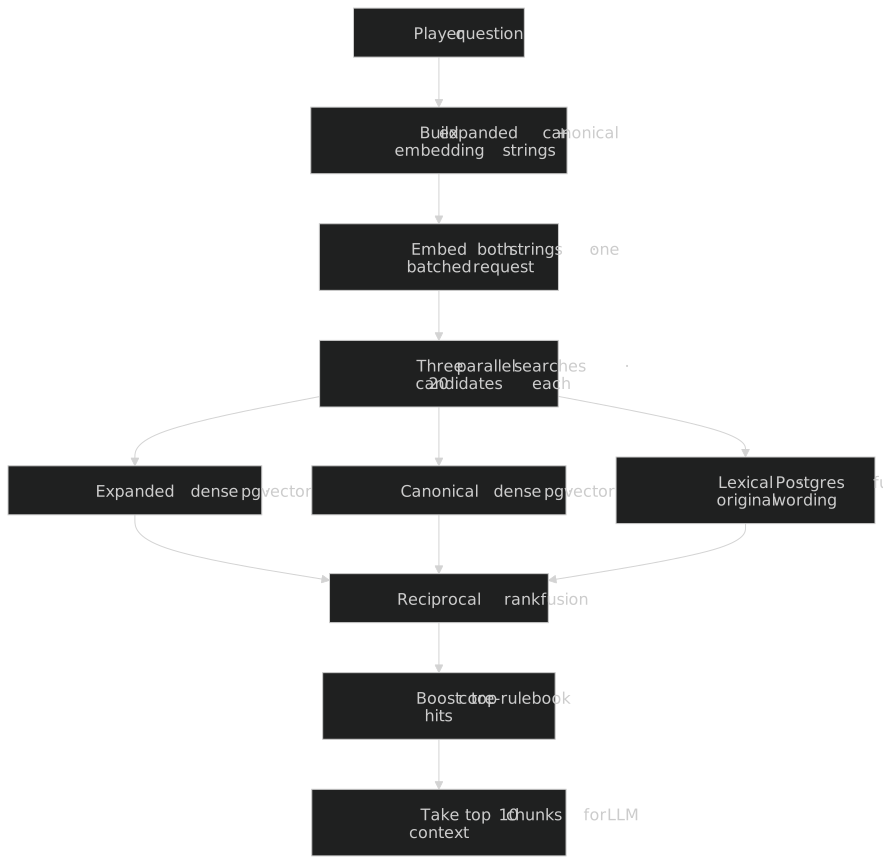
Each search lane skips chunks marked is_superseded = true. That flag goes on the old rule text in the parent book. The FAQ or errata document is ingested separately, with the replacement wording, and stays searchable. I am not throwing away the update. I am hiding the zombie.
After fusion I boost core rulebook hits (expansion PDFs outnumber core and bury it otherwise), then take the top ten into context.
Fusing with Reciprocal Rank Fusion
Three lists come back. I merge them with Reciprocal Rank Fusion (RRF): chunks that rank highly in multiple lists accumulate score. Consensus beats a single lane’s confident misfire.
function rrf(lists: ChunkRow[][], k = 60): { chunk: ChunkRow; score: number }[] {
  const scores = new Map<string, number>()
  const chunkById = new Map<string, ChunkRow>()

  for (const list of lists) {
    list.forEach((chunk, rank) => {
      scores.set(chunk.id, (scores.get(chunk.id) ?? 0) + 1 / (k + rank + 1))
      chunkById.set(chunk.id, chunk)
    })
  }

  return [...scores.entries()]
    .sort((a, b) => b[1] - a[1])
    .map(([id, score]) => ({ chunk: chunkById.get(id)!, score }))
}
k = 60 dampens rank so first place in one lane cannot automatically crush a chunk that placed second or third in all three. For the Warlord question, RRF is what lets Bases and Heroes show up in the same context window The rule text actually passed into the answer model for one query — here, the top-ranked chunks assembled after retrieval. Everything in the window is visible to generation; everything left out might as well not exist for that answer. .
Generalizing with an Alias Table
Hand-authoring [warlord (hero)] strings does not scale across game systems. Once the three-lane shape worked, I automated the substitutions.
After a rulebook is ingested, an extraction pass runs over its chunks (pnpm extract-aliases). An LLM proposes alias relationships (warlord → hero, horse → mount). Each row needs an evidence quote that appears verbatim in a source chunk before I insert it into concept_aliases. That table is part of the ingest pipeline, not something I maintain by hand at query time.
At query time, alias matches rewrite the embedding strings only. The player’s question stays unchanged in the answer prompt. When no alias matches, expanded and canonical collapse to the same text and I pay for one embedding instead of two.
The table did not solve the Warlord case. The canonical lane did. The table makes the next alias gap cheaper to close without redesigning retrieval.
Supersession at Ingest Time
FAQ replacements are the second failure mode from above. My bias is to fix problems at ingest when I can. Ingest runs once per document. Queries run all night at the table. Supersession fits that shape: resolve which parent chunk is dead during FAQ ingest, store the replacement in the FAQ document itself, then filter zombies at query time with a boolean flag.
The matching logic stays game-agnostic: section names, page references, text search, vector fallback, LLM confirm. Nothing hard-coded to one game’s unit list. Any tabletop corpus with errata should be able to ride the same path.
When an FAQ or errata document lands, I try to find the parent rule it replaces, in order:
- Section name matched against the parent chunk’s heading path.
- Ability name searched in parent chunk text (for corrections buried inside a larger section).
- Page reference parsed from the FAQ heading or body, matched against parent page ranges.
- Vector similarity A score for how close two embedding vectors are in meaning-space. Higher similarity means the passages are semantically nearer; lower means farther apart. Cosine similarity is one common measure. Used here as a fallback signal when section names and text search cannot link an FAQ to its parent rule. at threshold 0.60, only as a last resort.
Candidates merge and dedupe. A small LLM call confirms each pair. On confirmation I set is_superseded = true on the parent chunk only. The FAQ chunk that carries the new wording stays in the index. At query time every lane filters out superseded rows, so retrieval surfaces the replacement text instead of the zombie rule.
Conclusion: Ten Fused Chunks, Zombie Rules Filtered Out
By the time retrieval finishes, I have ten chunks that survived multi-lane fusion and core boosting, with outdated parent rules filtered out but FAQ replacements still in the pool. Structural Truth from Part 1 still lives inside each chunk. This layer makes sure the right chunks arrive.
Getting context into the model is only half the work. The other half is stopping it from paraphrasing those chunks into fiction.
In Part 3: Prompting, I cover the JSON field ordering that forces the model to quote before it answers.